| |
|
|
|
Products & Services
|
|
| |
| ► Offshore & Singapore Company Incorporations |
| |
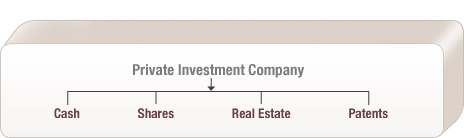
Offshore companies are used by individuals and corporations as investment vehicles, and for estate and tax planning
5
Amongst the more common uses of offshore companies are: |
| |
1. Investment Vehicles
5
The purpose of an Investment Holding Company is to hold a portfolio of investments in a safe, confidential and tax-efficient manner. With direct cross border investments, the selection of a suitable corporate structure can allow for the utilization of international tax treaties to minimize income, withholding and capital gains taxes.
2. Asset Holding
5
In many countries, it can be beneficial for a foreign investor to purchase property through an offshore company incorporated
in a tax efficient jurisdiction. |
|
3. International Trading
5
It can be advantageous to interpose a Company between the buyer and seller, thereby accumulating a part of the profit of the transaction in a low tax center. Such an arrangement may also help minimize the impact of Exchange Control provisions.
4. Commission Companies
5
Commission Companies receive commission income in a tax efficient manner, on the basis of the beneficial owner acting as a professional individual offering their services internationally. |
|
| |
Heritage Trust Group has a global access to offshore incorporations. Our team of professionals can assist to identify a suitable jurisdiction to meet your specific objectives and requirements.
Heritage Trust Group is able introduce clients to a full range of trust services. Our team of associates' collective experience provides a wealth of knowledge to draw upon to assist you tailor trust solutions from the initial planning stages through to implementation. We assure a high standard of service, whilst offering the highest level of sophistication when planning your trust structure. |
|
| |
| ► Fiduciary Services |
| |
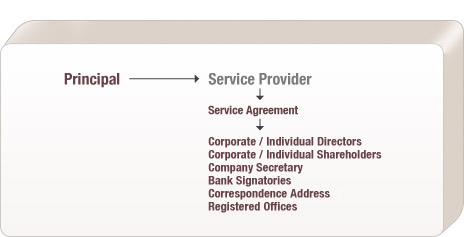
Clients who establish offshore companies may usually require professional services in the administration and management of these companies. With a good understanding and strong respect for confidentiality, our managers can provide efficient management for your offshore structure. |
| |
Our suite of services include:
5
• Corporate / Individual Directors
• Corporate / Individual Shareholders
• Company Secretary
• Bank Signatories
• Correspondence Addresses
• Registered Offices
• Offshore Bank Account Opening
Our professionally qualified and experienced managers will produce and maintain all necessary paperwork and orrespondence to allow for the prudent and efficient administration of your company, and its affairs. |
|
|
| |
| ► Client Accounting Services |
| |
At Heritage, we pride ourselves on providing high quality accounting services, covering the following areas:
5
• Non-Audit Financial Reporting Services (FRS) for Singapore Companies
• Compilation and Analysis of Financial Statements for Singapore and Hong Kong Companies
• Preparation and Submission of Tax Returns for Singapore and Hong Kong Companies |
|
| |
| ► Trust Services |
| |
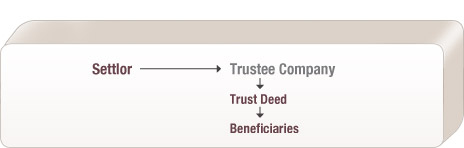
A trust is essentially a wealth management tool, which is higly effective when professionally managed. A trust is a legal arrangement which can fulfill a range of objectives including, the confidentiality of asset ownership, or estate, mitigating estate and other tax exposures, and maximising investment opportunities. Generally, a trust constitutes the settlor, transferring the legal ownership of assets to the trustee(s), under the instruction that the assets be held for the exclusive benefit of designated individuals or corporations called the beneficiaries.
5
Trust establishment can be used for the following purposes: |
| |
1. To provide confidentiality in ones financial affairs
A trust can achieve anonymity as the legal owner of the assets is the trustee. Furthermore, the settlor can still execute a degree of influence over the trust assets even if he is one of the beneficiaries.
2. To integrate personal assets from business assets
5
Modern offshore trusts can be flexibly structured to give trustees a large degree of discretion over the management of assets.
3. To provide protection from estate or inheritance taxes and for tax planning purposes
5
Tax protection has long been known as one of the better uses of a trust. Assets properly held in a trust by an offshore trust may not be subject to tax upon the settlor's death, even if there are changes to the onshore tax legislation. |
|
4. To plan for proper wealth inheritance and provide protection for the preservation of family wealth
5
Trusts are an extremely effective structure to use when dealing with family assets and the individual rights of the family members over those assets. A trust protects against wealth fragmentation often as a consequence after immediate distribution to heirs upon death. Distribution intervals of the trust to the beneficiaries can be stipulated and placed under the trustee's control to best look after the interest of the beneficiaries.
5. To provide creditor protection of assets
5
Trusts can reduce tax liabilities, and protect assets from future creditors or certain civil suits to the extent permitted by law. In the event when new unfavourable legislation is implemented, trusts can prevent your assets from being seized or blocked. |
|
| |
|
|
|
| |
| ► Other Services |
| |
Mailbox & Phone Answering Services |
| |
Phone Answering Services
5
We assist in handling all incoming calls and forwarding messages on your behalf during normal working hours (9.00am to 6.00pm - Mon to Fri).
Facsimile Services
5
If you need to send or receive faxes but do not have a fax machine of your own, sign up with our facsimile servies. All fax transmissions received on behalf of your company / firm will be redirected to you at your designated address.
Registered / Correspondence Address & Mail Box Services
5
We provide prestigious, prime location registered / correspondence address services for your company / entity. All correspondence received by us on behalf of your company / entity will be re-directed to you unopened to a specific address as instructed. Alternatively, we may also hold the mail for weekly / monthly collection by you or your designated person. Correspondence address in other jurisdictions where Heritage is represented, are also available on request.
|
| |
|
| |
| ► Islamic Banking and Finance |
| |
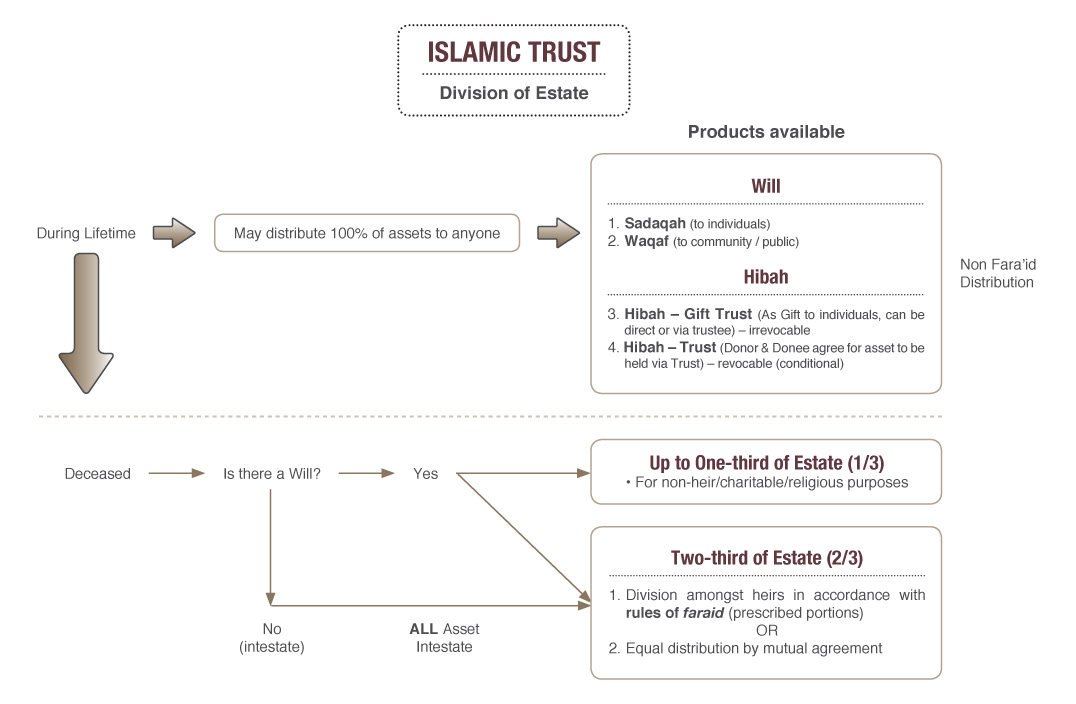
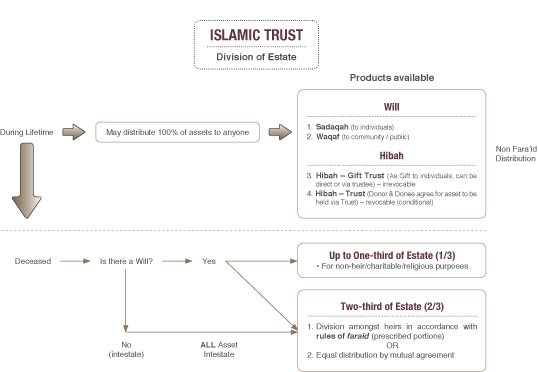
Basic Principles Underlying the Division of Estate Under Islamic Law |
| |
The following is an understanding of Inheritance Issues under Islamic Law. Clients should not rely solely on these guidelines, but should seek advice from a Shariah Scholar for their specific situations.
Under Islamic Law, a testator may dispose only one third of his or her estate by will. The rest must be divided among the heirs in accordance with the rules of faraid (forced heirship prescribed portions):
7
| |
●
|
A son inherits a share equivalent to that of two daughters.
This faraid principle which the Quran first lays down refers to males and females of equal degree and class. |
|
| |
●
|
If there are only daughters, two or more are to share two thirds of the estate; if there is only one daughter,she receives one half. |
|
| |
●
|
Parents, both mother and father, are each entitled to one sixth, if the deceased have children, but if there are no children, and the mother is the only heir, then the mother receives one third. However if the deceased left brothers and sisters, the mother receives one sixth. |
|
| |
●
|
A husband is entitled to a half share of his wife’s estate, if there are no children; if there are children, the husband’s share is one quarter.
|
|
| |
●
|
A wife is entitled to one quarter share of her husband’s estate if there are no children; if there are children, she receives one eighth.
|
|
| |
●
|
If the deceased has left neither ascendants nor descendants, but has a brother and/or a sister who survive him, each gets one sixth, but this is subject to a maximum cap of one third of the estate. In other words, if there are more than two surviving siblings, they all share in a third of the estate. |
|
The above lay down the basic principles for the division of the estate. The heirs when entitled are given their fixed shares and the remaining estate is inherited by the residuaries.
Certain heirs referred to as primary heirs are always entitled to a share of the inheritance, they are never totally excluded. These primary heirs consist of the surviving spouse, both the parents, the son and the daughter. All remaining heirs can be totally excluded by the presence of other heirs.
If there is any residue left after the sharers have received their share, and there is no one entitled to it, then, according to some jurists, this residue is to be divided proportionately between the sharers as long as it does not contravene the Quran. |
 |
| |
Sources : |
● Islamic Law And Society, An Introduction, Jamila Hussain, 1999
● Muslim Family Law, Third Edition, David Pearl and Werner Menski, 1998
● Islamic Banking & Finance In South-East Asia, Its Development & Future, 2nd Edition, Angelo M
Venardos, 2006 |
|
| |
|
| |
|
|